
It's official water-ice is on Mars! Check out the Emily Lakdawalla's blog on the Planetary Society for a great article!
Showing posts with label mars. Show all posts
Showing posts with label mars. Show all posts
June 22, 2008

May 31, 2008
We've Struck Ice (we think)!!!

What you are looking at researchers are fairly certain is a layer of ice excavated by the blast of Phoenix's retrorockets.
The possibility still exists that it's just rock, however, I doubt geologists would make that mistake, even with a black and white photograph. I was really hoping for a full color photograph letting us know once and for all if this is what we came to find, or if it's just a layer of rock. Based on the smoothness and the behavior of the soil around it, NASA's putting their money on ice.
The way we look at Mars just changed. Forever.
May 30, 2008
In Honor of New Mars Fever

Since everyone seems to be talking about Mars these days with the lander firmly and safely on the surface, I thought I'd post the winning photo captured by Spirit in Gustav crater back in 2005.
Kind of looks like the second sun setting on Tatooine...
This picture always leaves me breathless and I thought I'd come up with an excuse to post a three-year-old photograph.
Enjoy!
Image Courtesy of NASA/JPL
May 29, 2008
Coolest Landing Pic Ever
Want to see your tax dollars at work? Nothing says it better than the breath-taking oblique angle photograph of the Phoenix lander, it's parachute, and its parachute lines descending into (actually past) the "Heimdall" crater!
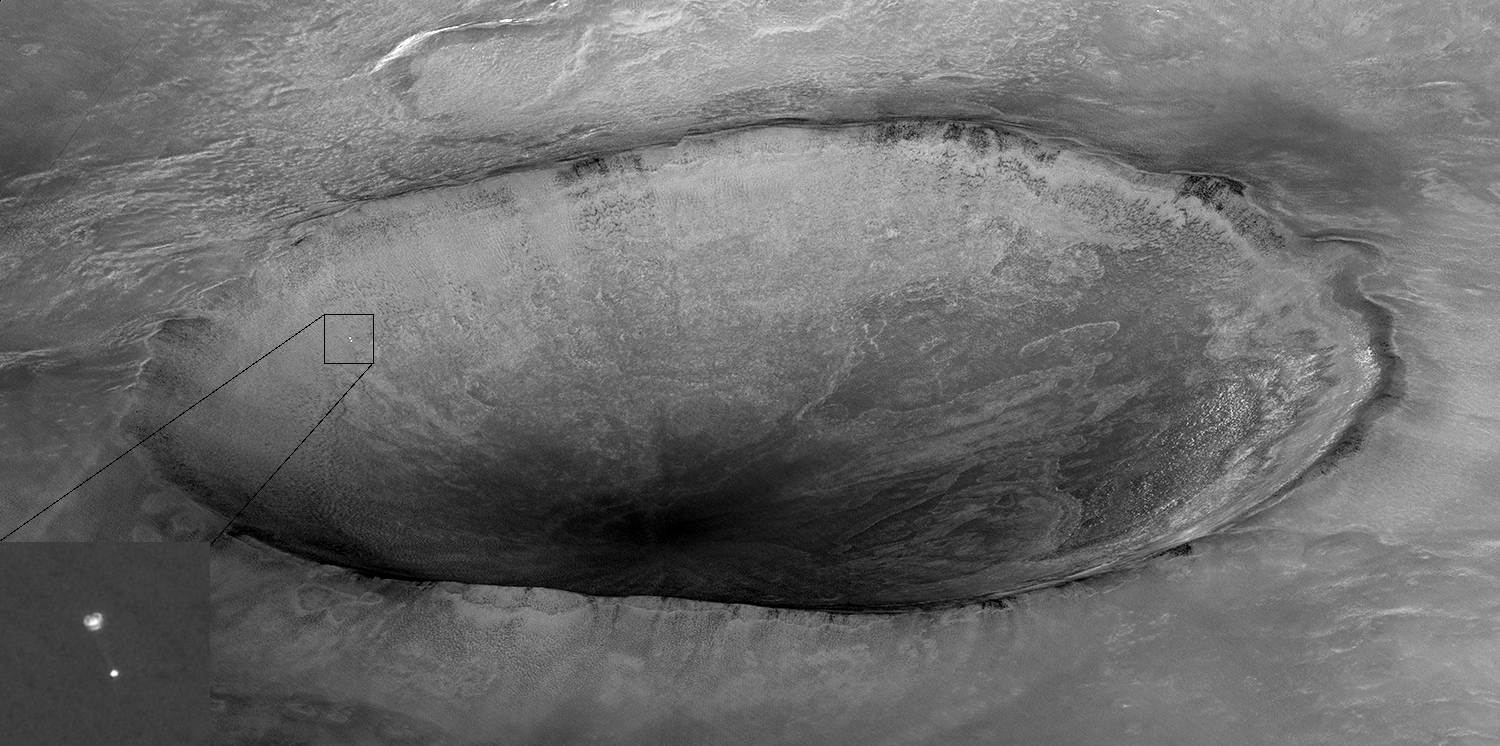
A satellite we launched 42 million (give or take a few million) miles to orbit the planet takes a photograph of the entrance of another spacecraft we send to check for samples.
Your viewing the first ever photograph of a spacecraft landing on another world taken by a camera not attached to it.
This is history. Now Phoenix... find us some water, and some life!
EDIT: Changed post title. Yeah, I totally copied the title of Bad Astronomy blog's post. Sorry. It REALLY wasn't intentional.
December 29, 2007
Mars Near To Earth

This is a photo I took of Mars two nights ago. Mars is currently near its closest point to Earth, and I wanted to snap a shot before it returned in 2016!
December 18, 2007
Mars At Its Closest Photograph
Here's a few pictures of Mars while at its closest point to Earth:
 This is a photo by Alan Dyer of what Mars looks like from Earth in an overexposed photograph. Check out how much brighter it is than Orion!
 Hubble released this image yesterday of Mars at its closest point to Earth. Great time for Mars astrophotography!
December 17, 2007
Mars Comes Closest to Earth Tomorrow

Mars will be at its closest point in it orbit to Earth tomorrow. Mars already is an extremely impressive object with its hue very easily distinguishable as red.
 Courtesy of Sky & Telescope Observing Blog, we have this handy chart to help us plot Mars' position in the sky, though it's really a formality at this point since it is so easily visible. Look to the constellation Gemini, and it should be easily visible as it is by far the brightest object in that section of the sky.
On an astrophotography note, I've found that Mars is notoriously difficult, at least for me, to photograph. I seem to get lots of streaks, trails, and other problems. I will be getting my gear out shortly to see if I can get a good Mars shot as I add Taurus and Gemini to my constellation list.
Check out the post at Sky & Telescope for more detailed information on what telescope, filters, etc. will give you the best view of Mars.
Michele at the Earth and Weather blog has a great post on the subject as well. Enjoy it; Mars won't be back like this until 2016.
November 30, 2007
Lights With No Sun

The ESA's Rosetta, the first ever spacecraft whose destination is a comet, took this picture of the Earth at night. Large cities are clearly visible as mankind's presence on this planet is clearly visible-- even when the Sun is not.
Rosetta has a super complex trajectory is making its course to comet 67P Rosetta. This includes not one, but three gravity assist maneuvers around Earth and another around Mars. This truly will show how efficient current technology can accurately predict the course of our probes.
Once reaching comet 67P Rosetta, the craft will remain in orbit with the comet during its journey to and from the Sun. In a nutshell, Rosetta will ultimately tell us what comets are made of, why they are different (or the same) as other intersolar materials, and give us a better idea of what the surface of a comet actually looks like.
 Interesting mission to be sure, and likely it will present us with new information while verifying what we already know about comets. The study of the origin of comets never looked so sweet... just check out this picture of a very overexposed Mars taken by Rosetta's wide-angle camera against the stunning backdrop of our Milky Way. Every astrophotographers dream--wide angle astrophotography with a twist: no atmosphere!
November 11, 2007
Mars Phoenix Lander

My thoughts frequently drift to the Mars Phoenix Lander, which at this moment in time, is hurdling through space at astounding speed to the red planet Mars.
The Phoenix will once for all run definitive tests on the orangish-red soils of our less than hospitable neighbor. In honor of my thoughts and wishes for the Phoenix team, I am creating a countdown clock until the day Phoenix lands. Once it lands, who knows what it will find out about the organic (or inorganic) history of Mars' geology.
October 19, 2007
Mar's Soil Contains 16% Water New Research Says

In perhaps one of the most significant scientific discoveries on Mars this century, and in light of recent claims Mars' past may have been drier than previously thought, researchers are conclusively saying that water still remains on the surface of Mars.
The canyons and canals that are hypthesized to have contained Martian water may actually have because Spirit's X-Ray spectrometer called APXS captured significant data about the water.
Oceans and surface water likely evaporated, but not before much of the water went underground and much of it trapped in mineral compounds beneath the surface.
However, we still do not know how or why the Martian water is gone...
September 28, 2007
The Notorious Mars Email
 "Mars is coming! Mars is coming!"
That's a familiar subject for email that clogs Exchange servers about every two years about how Mars will be as large as a full moon. This, of course, is totally false. The picture above is often pictured in the email. Stop the email people! We all fell for it once (and don't say you didn't look!) but we know its not that big!
However, there is a bit of truth. Mars will be in the best viewing position for years and it will blaze with a magnitude of -1.6 by December 9th; brighter even than Sirius. You can find Mars between Taurus and Gemini.
Every 26 months, the orbits of Earth and Mars come closest. This makes Mars' magnitude greater and astronomers get their best every-other-year look at the Red Planet.
September 22, 2007
Mars' Hidden Subsurface Entrances

The Mars orbiter is now fully operational after a software glitch sent it into safe mode on September 14, 2007. It is expected to resume its search for caves like the ones reported back in April that were discovered using Odyssey's thermal imaging system (THERMIS).
Caves are likely hotspots for martian microbial life. They show up as "warm spots" on thermal imaging because they are warmer during cold periods and cooler during hot periods and offer a much more stable temperature to sustain life. Caves are important discoveries on Mars because:
1.) Caves can be used as future shelter for humans.
2.) Microbial life may be located in caves beneath the surface.
3.) If life is absent, the fossil record preserved in the cave wall will tell us if life ever existed, and if so, what happened to it.
For these reasons researchers hope that caves will be more thoroughly investigated by future missions. A very important discovery was the potential cave system located near Arisa Mons, a massive martian volcano. The caves have been dubbed the Seven Sisters, named Dena, Chloe, Wendy, Annie, Abbey, Nikki and Jeanne, after the loved ones of researchers who located them.
Subscribe to:
Comment Feed (RSS)


