

Gliese 581 c, the incredibly creative name of a planet found orbiting red dwarf Gliese 581, is not like any exoplanets we know. Most exoplanets are huge, massive, gas giants. They often are hot as lava, called hot 'jupiters', or five times as cold as our arctic. But not Gliese 581c. If we had to pick which exoplanet had life on it, all bets would be on Gliese 581 c, and here's why.
Gliese 581 c is located in "the habitable zone". The habitable zone is the exact distance from the Sun (or another star) that a planet can be at that liquid water will not permanently freeze or completely evaporate. Gliese 581 c is located within the habitable zone of its star, Gliese 581, and if liquid water were present on the surface, it would act and behave much the same way it would on Earth. Current models predict Gliese 581 c is either a very rocky planet, or a complete oceanic planet, with no visible land. Either way there is no way to know for sure (yet) what the surface of this planet holds.
All bets are on Gliese 581 c. Gliese 581c X-Prize anyone?
October 1, 2007
Gliese 581c: An Extrasolar Earth?

Fire & Ice

When a planet is "tidally locked", it is similar to the relation the Earth and Moon share. It means that the same side of the planet is facing the star, so if Earth were tidally locked, there would be no days, no rotation, just a world that would be half day and half night... forever.
This particular phenomenon creates an interesting mixture in exoplanet Upsilon Andromeda b. The planet is tidally locked with its parent star, so one half of the planet is hotter than lava; the other half less than freezing. The temperature range of this exoplanet is astonishing: from -4 to more than 3000 degrees Fahrenheit.
September 27, 2007
The Hunt for Exoplanets
The universe is an ever changing place; or least it is to astronomers. Most of us when we were in school remember that there were only nine planets in the entire universe. Now there are eight planets in our solar system, several named Pluto-sized objects near the Kuiper Belt, and more than 200 discovered planets in faraway solar systems.
The consistent, repeated discovery of exoplanets is very exciting to the astronomical field. The process of discovering exoplanets is very intriguing indeed. There are actually two primary methods for exoplanet discovery: the transit method and the wobble method.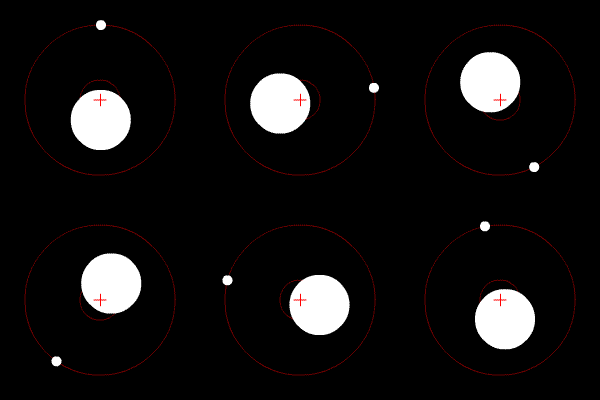 In the wobble method, a large planet, like Jupiter, orbitting a star causes a slight wobble in the star and it moves slightly off of its center of gravity, like in the illustration. By making measurements of the star's "wobble" we can determine many characteristics of the planet. Nearly all exoplanets have been discovered using this method, but the method is severely limited: it can detect Jupiter-sized objects, but not Earth-sized objects. It is difficult, if not impossible, to determine what the composition of the planet is.
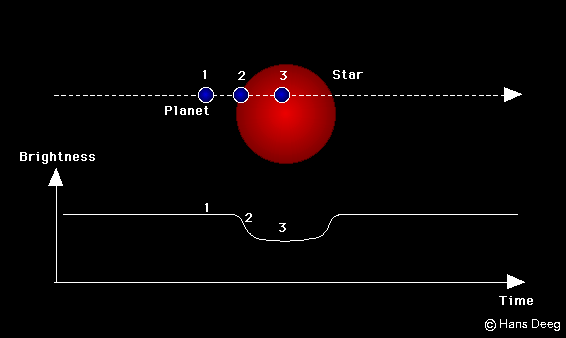 In the transit method, we can get much more information. The planet passes directly in front of the star. We can get mass, size, and even atmospheric information from this method, because light from the star pass through the upper atmosphere of the planet, which even allows for temperature and cloud formation measurements. The transit method unfortunately can provide many false detections and also many undiscovered planets will not pass perfectly in alignment with observations.
- Gravitational Microlensing
- Circumstellar Disks
- Pulsar Timing
- Astrometry
- Direct Imaging
 The vast majority however are discovered by the two afforementioned methods. Direct imaging is great though, because even though discoveries made with this method are rare, they do exist and for the first time give us a peek into neighboring star systems, like this picture of GQ Lupi and its planetary companion GQ Lupi b.
September 26, 2007
Pollux: The Twin's Secret
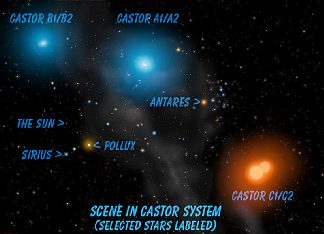 β Geminorum (more commonly called Pollux) is the head of the twin Pollux in the Gemini constellation. Pollux has a secret he has been hiding for millions of years though.
Pollux is the only star readily visible in the sky that has a confirmed companion (i.e. exoplanet). For thousands of years this has been a significant star and last year it was confirmed for a fact that Pollux has a companion star. So when you look at the head of the twin Pollux, you are looking directly at a confirmed solar system with orbitting planets.
A few interesting facts about Pollux:
- Even though it has the "Beta" designation, it is actually brighter than α Geminorum, more commonly known as Castor.
- Castor and Pollux are twins; however, the stars representing them couldn't be more different. Castor is a super hot white sextuple star system; Pollux is a yellow-orange giant.
- Pollux is the only star readily visible in the night sky with a confirmed star system.
September 25, 2007
55 Cancri: Enter the Habitable Zone
 Nearly 40 light years away, a cosmic stone throw, there exists an interesting star system. 55 Cancri is a star system much like our own: it has planets in the "habitable" zone.
 There are currently four confirmed planets in the star system. Three have masses similar to that of Jupiter, and the innermost, "habitable" zone, planet has a mass comparable to Neptune.
September 17, 2007
Alien Planet Dense as Balsa Wood (TrES-4)


